
2025 AIA CalGreen Checklists
The 2025 AIA CalGreen Checklists are here!
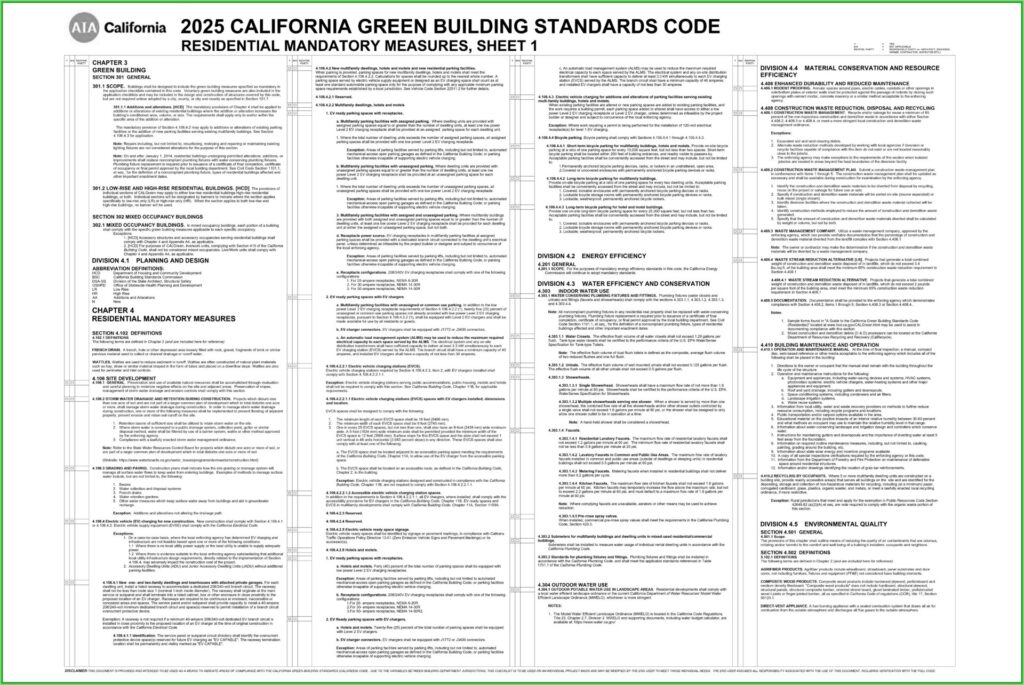
2025 CalGreen Residential Mandatory Measures (AIA is copyright of the American Institute of Architects)
The California American Institute of Architects (AIA) has published the updated 2025 Green Building Standards Code checklists. These include both the CalGreen Residential Mandatory Measures and the NonResidential Mandatory Measures. You can download PDFs of them from the following links:
2025 AIA Residential Mandatory Measures PDF
2025 AIA NonResidential Mandatory Measures PDF
To download the AutoCAD files go to the link for the AIA website here.
These checklists are provided by AIA California and are free to use. However, they must be edited to suit your project. Do not submit the checklist, as downloaded, for permit. Submitting an unedited copy of the checklist can cause permit delays or add unnecessary scope to your project. As a minimum it will cause issues during the end of construction as the contractor and building inspector try to determine which requirements apply to your project. This is especially true of the 2025 checklists that have added many new, project specific, requirements.
If you are unsure how to properly edit the checklist for your situation, reach out to a CalGreen specialist to help you. It will save you time and your clients, money.
Understanding the 2025 CalGreen Checklists

It is important to understand that the intent of the checklist is for the author to verify that each checked item on the checklist is actually shown on the permit plans.
The checklist is a tool to document for the plan reviewers and building inspector that the project has included the applicable CalGreen Code requirements into the design drawings and specifications. In itself, it does not place a contractual obligation on the contractor. You must show each item on the permit plans to ensure the contractor has included the requirements in their scope.
The reason this is so important is that the CalGreen Code allows building departments to enforce, or ignore, requirements based on local conditions and preferences. Identical projects that are located in two different jurisdictions may have very different CalGreen Code requirements. For this reason, you cannot leave it up to the contractor to infer what is required at the time of bid. The architect and engineers of record have a legal obligation to document the requirements for their project.
If you intend to fill out the checklist yourself, make sure that each item marked as “applicable” has a corresponding note or detail in your plans.
A diligent permit reviewer will verify that the noted items are shown on the plans. However, in many cases, this does not happen because the plan reviewers expect the design team to properly include the required code items. Failure to do so will result in delays to the project at closeout when the building inspector catches missing or incorrect items or details.
Submitting an unedited AIA CalGreen Checklist for permit exposes you to legal jeopardy for failing to exercise due diligence in your professional duties.
Understanding the 2025 CalGreen Checklists

If you’re confused about the 2025 AIA CalGreen Checklists, you’re not alone. It starts with the fact that the problems with the AIA checklists vary by jurisdiction. The CalGreen Code is unique from the other state building codes in that it encourages building departments to enforce or ignore requirements as they see fit. For architects and designers working in multiple jurisdictions this can create a lot of challenges.
Further confusion is caused by the fact that many jurisdictions in the state will not accept the AIA checklists for documenting compliance with the CalGreen Code. For example, you can’t use them in the City of Los Angeles, or Anaheim, Marin County, San Francisco, Palo Alto, Petaluma, Rialto, Redwood City and many more. All of these jurisdictions either have their own CalGreen Checklist, a GreenPoint Rated Checklist, or require the use of the ones in the CalGreen Code itself.
Some jurisdictions will accept the AIA checklist for nonresidential projects, but require the HCD checklist for residential projects.
It is important to verify which checklist is required for your project prior to permit submittal. To do this call the permit technician for the applicable building department – or just call us at the number below and we can tell you.
Another concern with the AIA checklists is that they do not explain the intent, or complete language, of the CalGreen Code. For those who do not specialize in the code, it may not be obvious that an item does not apply.
If your project’s jurisdiction has adopted the Tier 1 or Tier 2 requirements, the AIA checklists are essentially useless. Neither the AIA Residential nor AIA NonResidential checklists contain any of the Tier 1 or 2 requirements.
Help With Your 2025 AIA CalGreen Checklist

Filling out the AIA CalGreen checklist requires and in-depth knowledge of the CalGreen Code and the intent behind the language. The language in the checklist is an abbreviated summary of each code requirement. The person filling out the checklist must know the details of the specific code section and how it is interpreted by the code officials. This takes the knowledge and experience of a CalGreen specialist who has been trained in the code and is up to date on the latest version and amendments.
We will make sure that each item checked as “applicable” has a corresponding note or detail on your plans, by providing a copy and paste list of notes and/or clear recommendations.
At CalGreen Energy Services we are specialists in the CalGreen Code. CalGreen is our only business. If you have a CalGreen question please feel free to give us a call. We are happy to share our knowledge.
Call us today and let us show you how we can help with your project.
Gary Welch
Email: gary@calgreenenergyservices.com
Phone: 707-328-5299


Gary Welch has over 35 years experience in the field of sustainable building design. He is the CEO of CalGreen Energy Services. Gary is an ICC Certified CalGreen Special Inspector and Plans Examiner.