Sunnyvale CalGreen
Sunnyvale CalGreen compliance will likely drive your project costs higher than most other Bay Area jurisdictions.
The California Energy Code and the Green Building Standards Code set the highest standards for green building construction in the entire country. Yet some special interest groups have enough influence to push through additional code changes that further increase construction costs, while adding little in true value to the building owner.
In addition to the mandatory CalGreen and Energy Code requirements, the city has added requirements for Build It Green and LEED compliance on most new projects.
This article explores the complexities of green building permitting in the birthplace of digital gaming.
Sunnyvale’s Green Building Mess
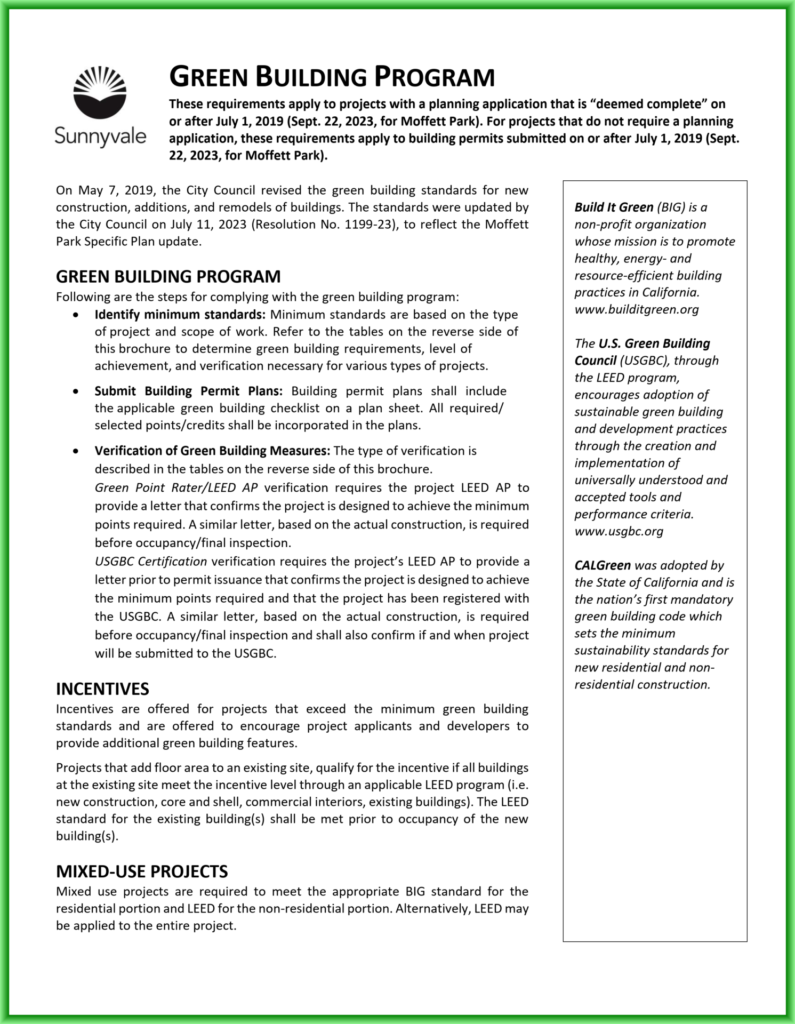
Sunnyvale’s CalGreen compliance path first requires you to review the Green Building Program document. It is five pages of different types of projects and different types of compliance paths. Variations that have different paths include new single-family dwellings, residential additions, residential remodels, multifamily new construction, multifamily additions or alterations, nonresidential new construction less than 5,000 square feet, nonresidential new construction greater than 5,000 to 30,000 square feet, nonresidential new construction greater than 30,000 square feet, and nonresidential alterations to structural, mechanical, plumbing, and electrical systems.
There are some “Voluntary Incentives” in the Green Building Program but we will not cover those in this article.
In all of the above cases, you must comply with the state code’s CalGreen Mandatory Measures. In addition, depending on where your project falls into the above, you may require a Green Point Rating of between 90 and 120 points (with the associated added costs), a LEED Silver rating, a LEED Gold rating. Inspections by a CalGreen Special Inspector, a Green Point Rating Inspector, and/or a LEED Certified Inspector will be required. There are very few, if any, green building specialists that carry all three ratings so your project may have to hire two separate “green building” inspectors.
All privately-owned Sunnyvale new nonresidential projects over 5,000 square feet must achieve and document a LEED Gold rating! And if you believe that LEED Gold does not add cost to your project (as some “experts” claim), I’ve got some prime real estate in Mono County I’d like to talk to you about.
Sunnyvale’s Residential Projects
New Single-Family or Duplex Dwelling
All new single-family or duplex dwelling units must comply with the CalGreen Residential Mandatory Measures. In addition, they must achieve a minimum of 90 point on the Green Rating Checklist. This means you will need to include a properly edited CalGreen Checklist and a filled out Green Point Rating Checklist on your permit plans.
The Green Point Checklist must include enough credits for at least 90 points. This may mean adding scope to your project that you have not budgeted for.
Once construction begins, a green building specialist must perform periodic inspections to verify that the contractor is following through with the required items. The green building specialist must submit progress reports to the Sunnyvale Building Department.
At the end of the project, a final green building inspection is mandatory. This will verify that all CalGreen Checklist and Green Point Rating Checklist items have been completed. The Building Department will not issue an occupancy permit until it receives these sign-offs.
Your project budget will need to include greater fees for a green building specialist for both the permit phase, and the construction phase for the multiple inspections.
Residential Additions, Alterations, and Remodels, including ADU’s
Requires compliance with CalGreen Mandatory Measures only. The program document seems to infer that this applies to a new ADU, however this should be confirmed with the building department. Varying interpretations are common when the code language is unclear.
Multi-Family Residential Development
First off, there is a bizarre lack of clarity on the definition of “multifamily” (also in the spelling). Even Volume 1 of the California Building Code does not define the term! Depending on the source, a multifamily dwelling may be two units, three units, or four or more units.
The bottom line is if your project has two or three units of any kind (duplex, condo, townhouse, etc.) you should get a determination from the Sunnyvale Building Department at the outset of the project. Classifying a project as multifamily comes with expensive, extensive code requirements.
Multifamily projects must document compliance with CalGreen Mandatory Measures by adding a properly edited Sunnyvale checklist to the permit plans. In addition, the plans must include a Green Point Rating checklist with a minimum score of 90. The Green Point Rating checklist must be certified by a Green Point Rater.
The program document “encourages” (ie: is not mandatory or enforceable) the project to include the following items:
• All-electric appliances in every unit (e.g. no gas line connection for the project); or
• Installation of a “cool roof” or “green roof”; or
• Install EV chargers; or
• Greywater, recycled water, and/or rainwater catchment system(s) or
• Gold-plated toilets
Ok, I added the last one because it makes as much sense as item number two. EV Chargers are mandatory by the CalGreen Code. Also, in the footnote to this list the program document states that, “Installation of Level 2 electric vehicle chargers are required at a rate of 12.5% of the required parking spaces for the development, with a minimum of one charger required.”
The footnote is strange in that the CalGreen Code, section 4.106.4.2.2.1.a, requires every multifamily unit be provided with a low power, Level 2 charging receptacle. It is not clear if the Sunnyvale document is superseding the state code and reducing EV charging requirements. Or is the city unaware of the state code requirement?
Multi-Family Additions, Alterations, and Remodels
Requires compliance with CalGreen Mandatory Measures only.
Sunnyvale’s NonResidential Projects
New Nonresidential and Initial Tenant Improvements, 5,000 Sq. Ft. or Less
Requires compliance with CalGreen Mandatory Measures only.
New Nonresidential and Initial Tenant Improvements, 5,001 – 30,000 Sq. Ft.
Requires compliance with CalGreen Mandatory Measures plus meeting the LEED Gold Level. This also requires field verification with a LEED-certified professional. The Gold certification requires between 60 and 79 points on the LEED rating system. This is far more complex and costly than the Build It Green Rating system. It will require a full-time LEED professional, in addition to increased scopes for the entire A&E team. Construction costs will be significantly affected.
New Nonresidential and Initial Tenant Improvements, >30,000 Sq. Ft.
Requires compliance with CalGreen Mandatory Measures plus meeting the LEED Gold Level. This also requires field verification with a LEED-certified professional. In this case, the Design Phase credits must be reviewed and approved by the US Green Building Council.
Major Alterations (structural, mechanical, plumbing, and electrical alterations)
Requires compliance with CalGreen Mandatory Measures plus meeting the LEED Silver Level. This also requires field verification with a LEED-certified professional.
Sunnyvale CalGreen. It’s Complicated
Whether your project is an ADU, new home, a warehouse, or the latest monstrosity of Silicon Valley, CalGreen Code compliance is complicated. Those who have worked in the city over the past 40 years have watched Sunnyvale push the building codes for increased safety and sustainability. For some of us, this feels like overkill. For the residents and building occupants, the benefits are real.
Real too, are the challenges in getting permits approved and building inspectors satisfied. For these reasons it helps to have a green building specialist supporting your project.
If you have a Sunnyvale project, please give us a call. Even if you don’t hire us, we are happy to share our knowledge on the CalGreen Code.
Email or call us now to see how we can help you:
Gary Welch
Email: gary@calgreenenergyservices.com
Phone: 707-328-5299
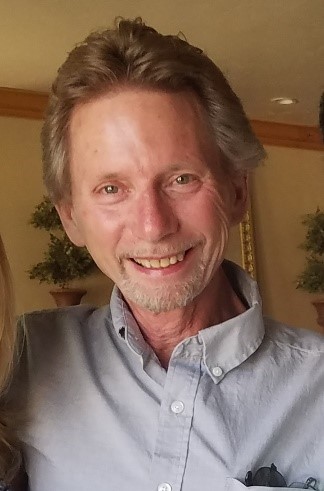
Gary Welch has over 35 years experience in the field of sustainable building design. He is the CEO of CalGreen Energy Services. Gary is an ICC Certified CalGreen Special Inspector and Plans Examiner.