
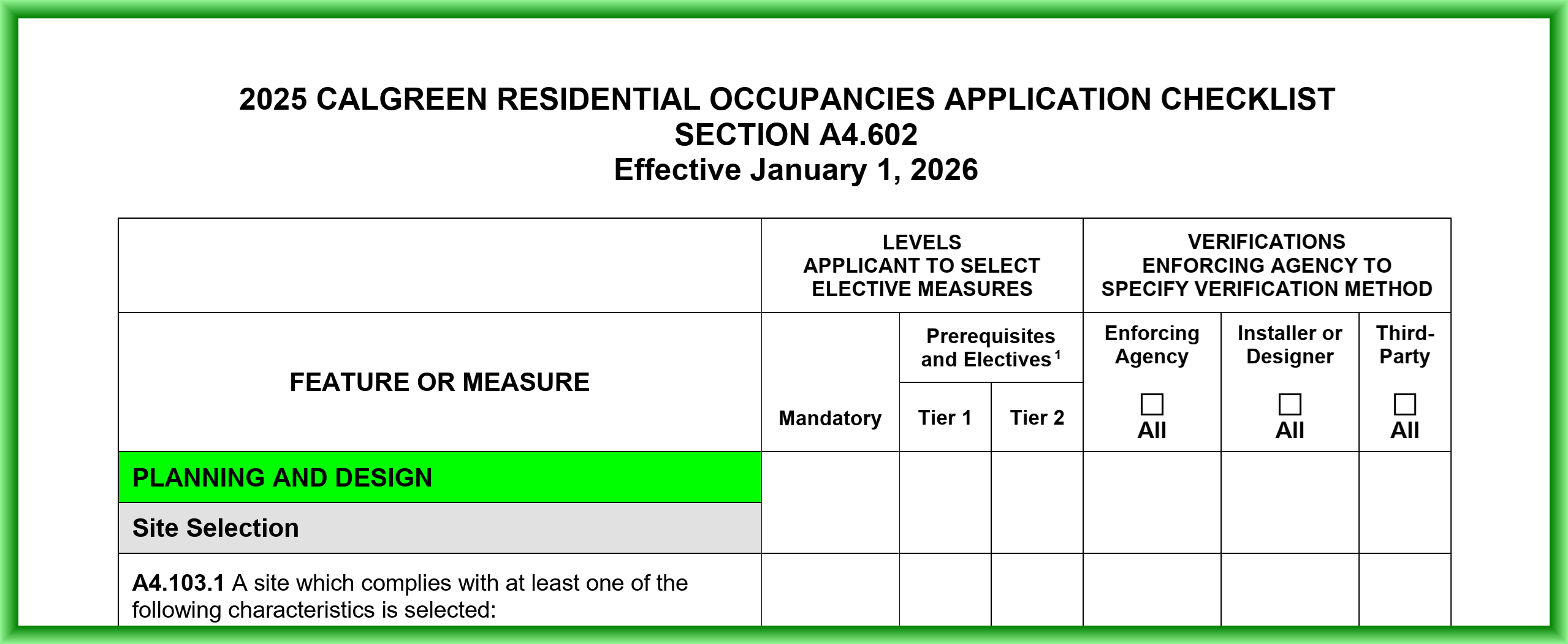
2025 HCD CalGreen Checklist is Here!
The new 2025 HCD CalGreen checklist is now available. The code and this checklist apply to all residential projects, including single-family residences, ADUs, townhouses, condos, multi-family buildings, dormitories, employee housing, assisted living homes, and other structures containing sleeping accommodations. You can download a copy of the 2025 HCD checklist from the link below.
The HCD checklists are a preferred method for demonstrating your project’s compliance with the California Green Building Standards Code. However, there is a wide variety of CalGreen checklists used throughout the state. The HCD checklist cannot be used in all jurisdictions. Many building departments have published their own CalGreen checklist to simplify their plan review and inspection process. Other jurisdictions have chosen to use the checklists published by the American Institute of Architects (AIA). It is essential to check with your project’s building department to figure out which checklist to use. If you submit the wrong checklist, it will be rejected, and you will have to change it during backcheck.
The HCD, aka the California Department of Community Development, is charged with promoting safe, affordable homes and vibrant, inclusive, and sustainable communities for all Californians. As a part of this charter, HCD works with the California Building Standards Commission to help clarify the requirements of California’s only green and sustainable code, the California Green Building Standards Code (CGBSC).
Those of us who have spent any time reading the CGBSC are aware of just how confusing this code can be. It does not follow the formatting of all of the other California Codes. In addition, unlike all the other California Codes, the adoption and enforcement of the code varies in almost every jurisdiction in the state. This is intentional, as the code is designed to allow cities and towns to adapt the requirements to their communities’ needs.
Additionally, the code allows building departments to adopt “voluntary measures” defined as Tier 1 and Tier 2. These tiers define increasingly ambitious sustainability or energy-efficiency goals. However, jurisdictions that adopt one of these tiers often do not adopt all the requirements, as some are costly or difficult to attain. Where this occurs, it is usually identified in their municipal code. If you would like more information on the CalGreen Tiers, you can see our informative article here.
Here is page one of the Calgreen Residential Mandatory Measures document HCD-SHL-625c :
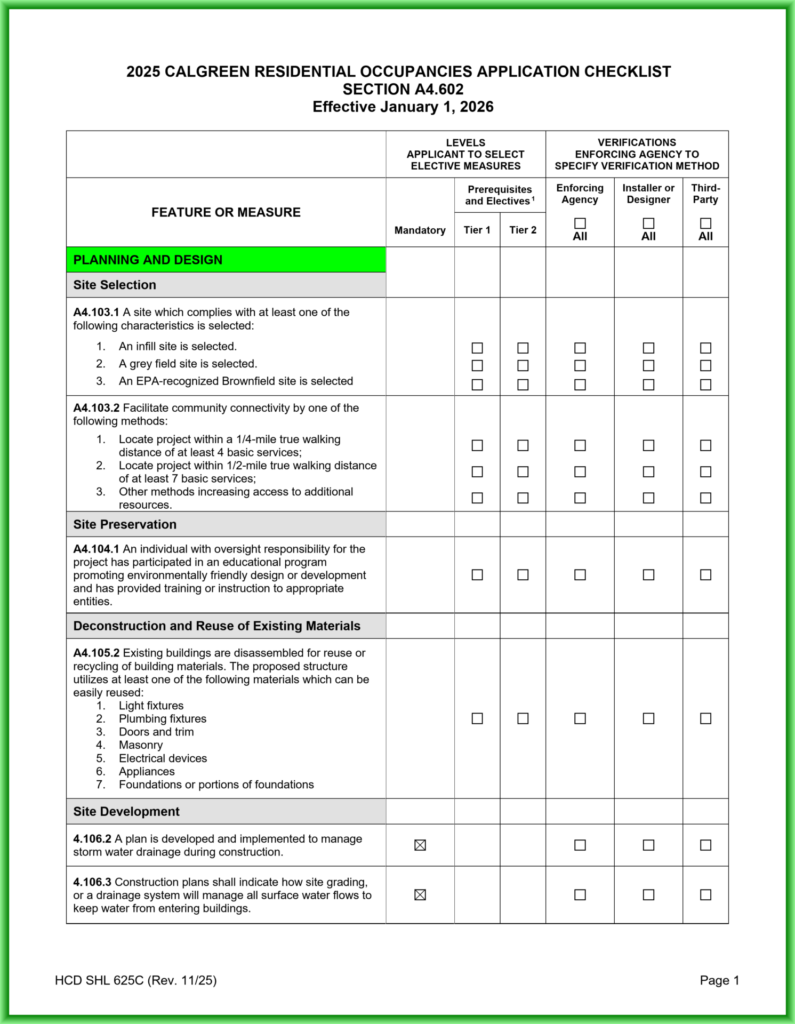
Page 1 2025 HCD Checklist HCD-SHL-625c
The 2025 HCD Checklist and Support Documents
HCD has published a series of supporting documents for the 2025 HCD Checklist. These include the following:
- HCD-SHL-625: A summary of the Residential Mandatory Measures
- HCD-SHL-625a: A summary of the CalGreen Tier 1 Measures
- HCD-SHL-625b: A summary of the CalGreen Tier 2 Measures
- HCD-SHL-625c: The 2025 CalGreen Residential Occupancies Application Checklist, including Tier 1 and Tier 2 (see image above)
- HCD-SHL-625d: The 2025 CalGreen High-Rise and Hotel/Motel Residential Occupancies Application Checklist, including Tier 1 and Tier 2 (note that this includes Energy Commission requirements, in addition to CalGreen requirements, and is specifically noted as, “This checklist is provided for user convenience. This checklist is not a 2025 CalGreen table.”
You can download copies of the documents above using the links below.
Unfortunately, none of these documents identifies changes from the 2022 code to the 2025 code. In some cases, the changes are very significant. In particular, there are increased requirements for electric vehicle charging at hotels, motels, apartments, condos, multifamily, and affordable housing projects. If you have a new project in one of these categories, the changes will drastically affect engineering, utility, and construction costs. For a detailed explanation of these changes, please see our article here. Affordable housing will no longer be affordable (see link below for our video on this subject)!
The Challenges of 2025 HCD Checklist
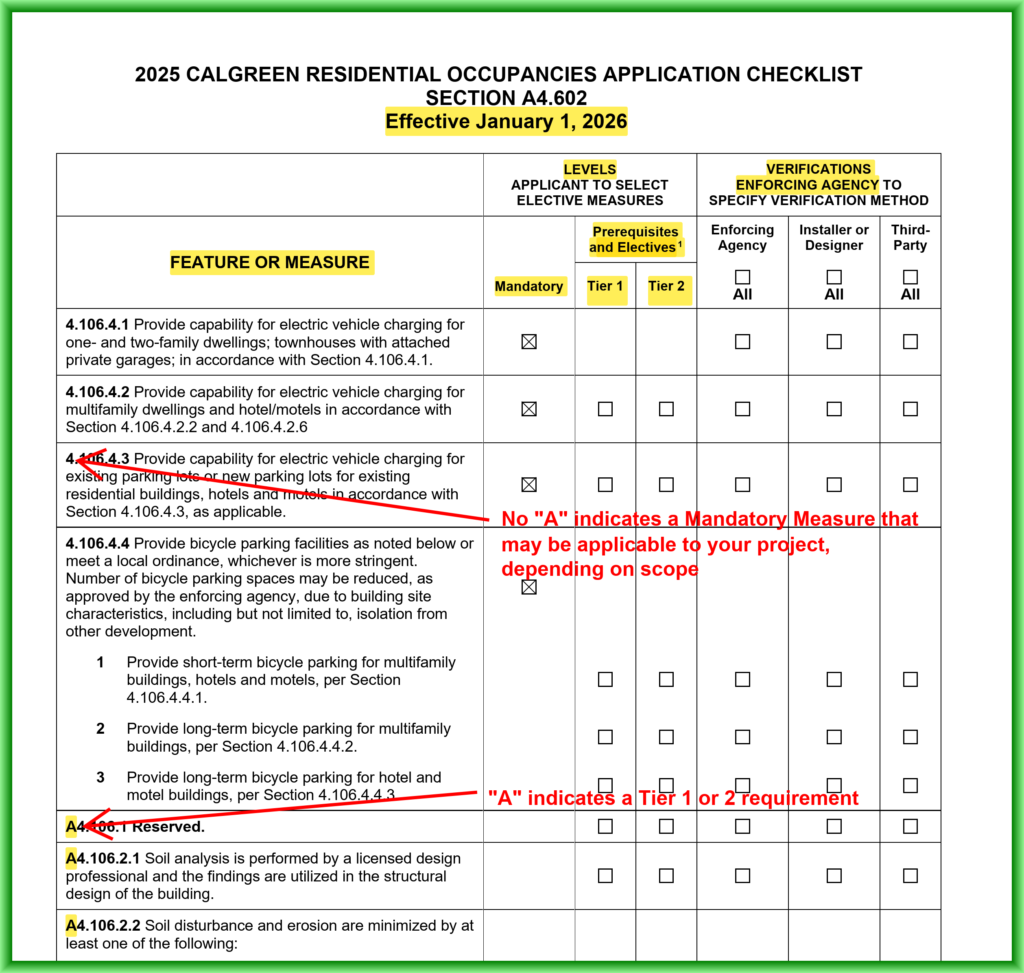
Page 2 of the 2025 HCD Checklist Marked Up to Show the Main Points
The HCD checklist is as confusing as the code itself. I have had more than one plan reviewer call me to ask me to explain it. I’m happy to do that, by the way! What makes it confusing is that it incorporates all of the Mandatory Measures, as well as the Tier 1 and Tier 2 measures.
If your project must comply with one of the Tiers, the 2025 checklist further confuses matters by not distinguishing between the prerequisites and the Tier voluntary measures.
Explaining the Tiers, the voluntary measures, and the required prerequisites is beyond the scope of this article. If you’d like to learn more about them, you can read our informative article here.
Here’s a breakdown of some of the things you need to know about the 2025 HCD CalGreen Checklist.
- The header consists of three primary columns – the feature or measure, the Mandatory & Tier Required, and who will perform the site verification.
- The Feature and Measures column follows the code numbering format. Note that some code sections are preceded by the letter “A”. The letter “A” indicates that this is a Tier 1 or Tier 2 requirement. If your jurisdiction has not adopted one of the Tiers, this section does not apply to your project. If you are required to comply with one of the Tiers, you will need to determine which of the “A” sections apply to your project.
- The Levels column consists of Mandatory and Tier sub-columns. Every section that applies to your project needs to have the respective box “checked” as part of your permit submittal.
- If any item in the Feature and Measures column does not apply to your project, you must give a brief explanation WHY it does not apply to your project.
- The Prerequisites and Electives column is only applicable if your project is required to comply with one of the Tiers. If in doubt, call the plans desk at your building department and ask (or call us, we are happy to help).
- The Verifications and Enforcing Agency columns need to be marked as to who will be doing the CalGreen verification/site inspections. In many cases, this is the local building department. In other cases, your project will need to hire a CalGreen Special Inspector to perform the inspections. You need to understand this at the time of permit application so that you can correctly mark these columns. If in doubt, call the plans desk at your building department and ask (or call us, we are happy to help).
It is essential to understand that the simplified language in the 2025 HCD checklist does not fully explain each code requirement. Each section is a brief summary. You need to read the full text of the 2025 CalGreen Code itself to make sure you understand the actual requirement and whether or not it applies to your project.
If you would like to see a summary of the changes in the 2025 Code from the 2022 Code addition, you can see our informative article here.
The 2025 HCD Supplemental Documents
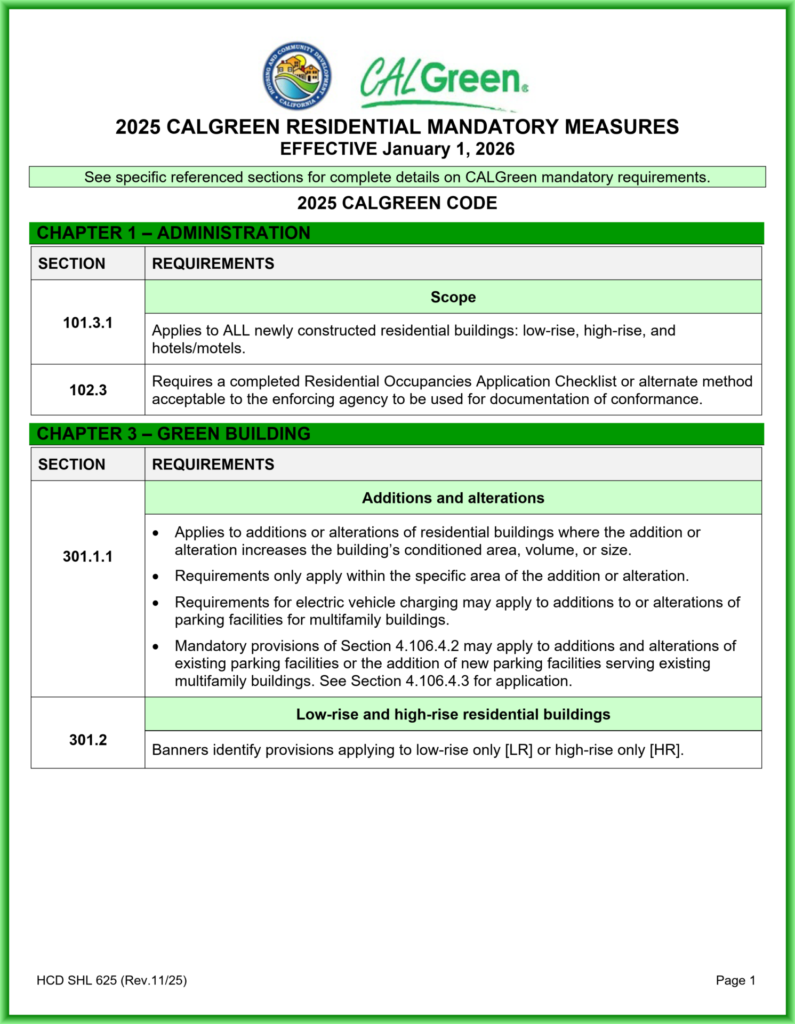
The HCD has published five documents in total related to the 2025 CalGreen code. Two of these are checklists, as noted above. The other three are summaries of the mandatory measures, Tier 1 requirements, and Tier 2 requirements.
Page one of the mandatory measures is shown in the image above. The document is labeled “HCD-SHL-625″ and is nineteen pages long. This handy summary shows a brief synopsis of each mandatory measures requirement. This can serve as a quick reference for architects, engineers, and designers to determine which sections may apply to their projects. It can also serve as a quality control review before permit submittal. What is most important about this checklist is the sentence at the top of the first page. It reads:
“See specific referenced sections for complete details on CALGreen mandatory requirements.”
The key here is that these summaries do not provide the complete text of the requirements, including what exceptions apply. When performing a code review for your project, it is essential to read the code itself. You can purchase a copy of the code from ICC here, either in hard copy or digital format.
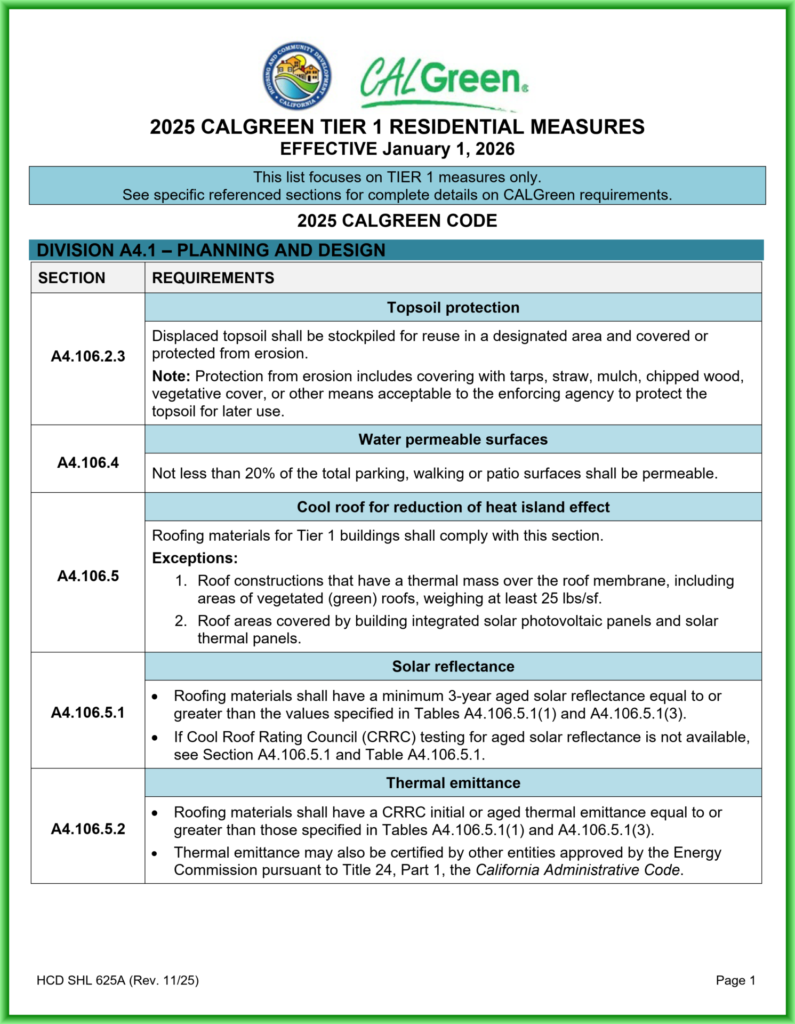
The document labelled “HCD-SHL-625a” is a summary of the Tier 1 measures required for the building design. The complete document is eight pages. However, this is a deceptive document! The sections summarized here are only a small portion of the Tier 1 requirements. What is not shown here are the prerequisites that must be part of the Tier 1 compliance. In addition, the Tier 1 electives are not shown either. Both the prerequisites and the elective measures must be included in your project to comply with the code. The HCD did a disservice by publishing this incomplete summary. It will add further confusion to an already confusing process.
Here is page one of the Tier 1 Residential Measures document:
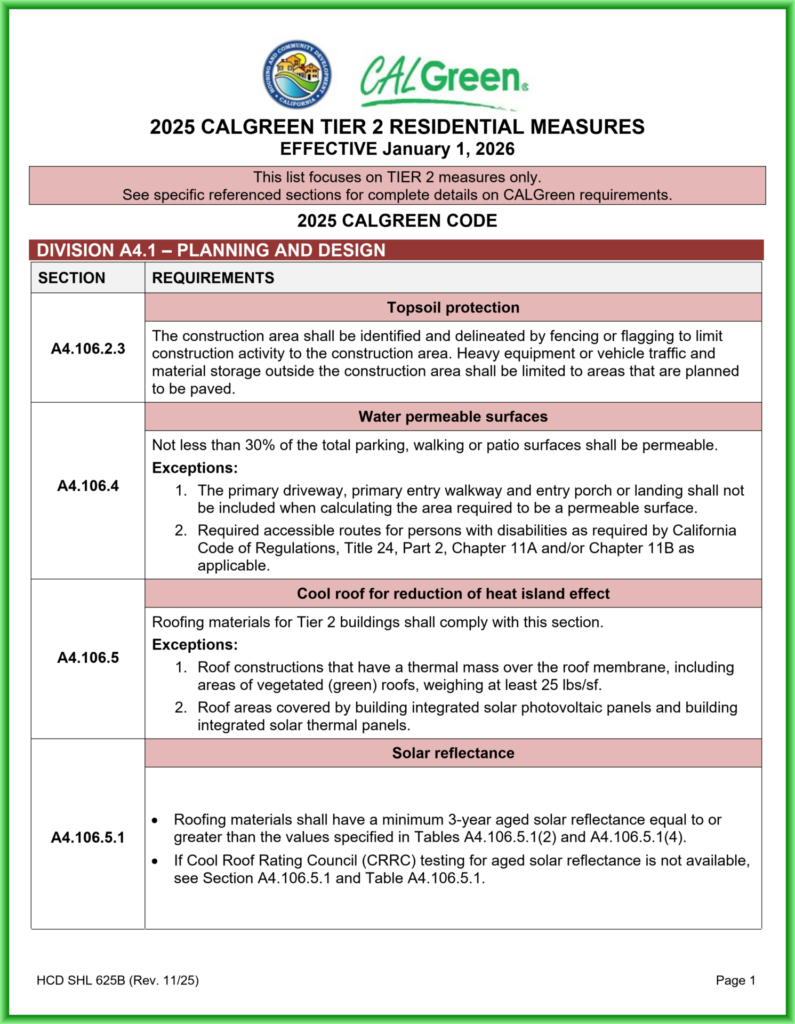
The document labelled “HCD-SHL-625b” is a summary of the Tier 2 measures. The complete document is seven pages. As with the Tier 1 document, the sections summarized here are only a small portion of the Tier 2 requirements. The prerequisites and the electives must also be included in the project design.
Here is page one of the Tier 2 Residential Measures document:
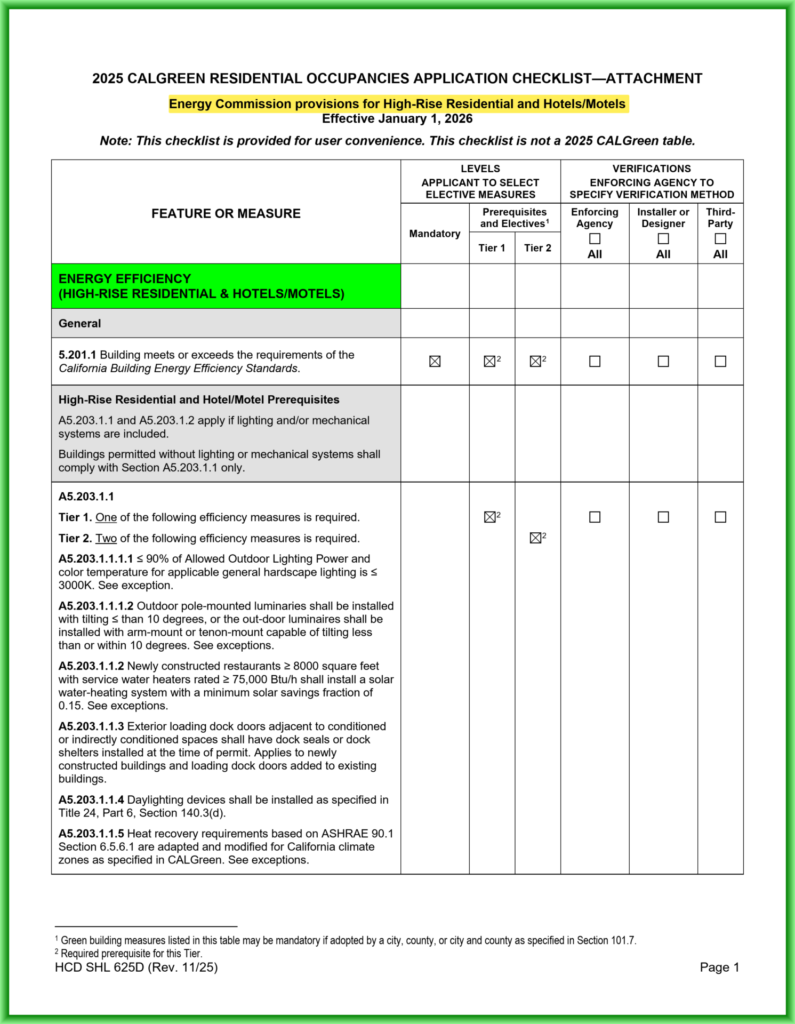
The last document in the HCD series is HCD-SHL-625d. The document is three pages long. It is titled as the “Energy Commission provisions for High-Rise Residential and Hotels/Motels”. It is noted as “not a 2025 CalGreen Table“. Say what? The point is that this checklist is not contained in the CalGreen Code itself. HCD has put this together to summarize the requirements specific to high-rise residential buildings, hotels, and motels. The checklist is a similar format to the residential occupancies checklist and includes the basic Tier 1 and 2 requirements. Once again, the prerequisites and electives are not shown, but you’ll need to include them in your project.
Here is page one of the High-Rise Residential and Hotels/Motels document:
Our intent in publishing these articles is to help industry professionals understand the CalGreen Code. While the code’s purpose is admirable, its execution is not user-friendly. If you happen to have a CalGreen Code question, feel free to give us a call. We are happy to share our knowledge. We promise we won’t try to sell you anything, including our services!
Download the 2025 HCD CalGreen forms here:
Call us today and let us show you how we can help with your project.
Gary Welch
Email: gary@calgreenenergyservices.com
Phone: 707-328-5299

See our video on the damage to affordable housing created by the changes to the 2025 CalGreen Code:

Gary Welch has over 35 years experience in the field of sustainable building design. He is the CEO of CalGreen Energy Services. Gary is an ICC Certified CalGreen Special Inspector and Plans Examiner.