
CalGreen for Contra Costa County
CalGreen for Contra Costa County is confusing because of missing and misleading information on the County website.
A search for “CalGreen” on the website returns several results, all referring to Construction Waste Management (CWM). This suggests that this is the extent of the “CalGreen” requirements. Nothing could be further from the truth. CWM is but a small part of the Contra Costa CalGreen requirements that your remodel or new construction project must comply with.
Many building departments no longer have the funding to keep their website up to date. Contra Costa County is no different. There is no information at all on their website about the rest of the CalGreen Code requirements.
In addition, the county has made amendments to the CalGreen Code.
These amendments do not appear in any readily available CalGreen Code checklist. They are not in the checklists published by the Department of Housing and Community Development. They are not in the checklists published by the California American Institute of Architects (AIA). And they are not included in the checklists published in the official CalGreen Code Compliance Forms.
When building code information is not readily available, it puts architects and designers at risk and results in costly change orders on construction projects.
There was a time when a municipal jurisdiction had an obligation to the community to publish its laws and codes, making them readily available to the public. Apparently, that boat has sailed, and it is now up to the general public to sleuth-out hidden code requirements. It’s not right, and it’s why we make the effort to write these informative posts.
CalGreen Mandatory Measures
The CalGreen Code includes mandatory measures for residential and commercial projects. These affect remodels, additions, and new construction projects. In this respect, CalGreen for Contra Costa County is similar to other jurisdictions.
For residential projects, the mandatory measures include:
- Storm Water Management During Construction
- Electric Vehicle Charging
- Water Conservation Measures
- Construction Waste Management
- Volatile Organic Compound Limitations
- Moisture Control
- Heating and Air Conditioning Design and Installation Standards
You can download a copy of the 2025 Residential Mandatory Measures here.
For commercial (nonresidential) projects, they include all of the above requirements plus:
- Deconstruction Measures
- Bicycle Parking (new requirements for 2025)
- Light Pollution Reduction
- Recycling By Occupants
- Entry Door Overhangs
- Landscape Design Standards
- Building Commissioning
- Temporary Ventilation
- Building LifeCycle Assessment
- Additional HVAC Requirements
- Acoustical Control Measures for Occupants
You can download a summary of the 2025 CalGreen NonResidential Mandatory Measures here.
The details of the above requirements are in the CalGreen Code. You can read the contents of the code here.
Note also that the California Energy Commission (CEC) creates Interim Updates that may not appear in this online version.
Unfortunately, a visit to the California Energy Commission website reveals no (none, zero) reference to the CalGreen Code, even though the CEC authors the code and promotes the changes through the legislature.
Is it any wonder that Contra Costa buries the green building requirements when even the CEC treats the CalGreen Code like the black sheep of the state’s building codes?
Hiding Code Requirements
CalGreen for Contra Costa County includes requirements not found in the CalGreen Code. They are neither shown nor mentioned on the county’s website.
Where are they?
The requirements only exist on the MuniCode.com website. This website is used by a number of other municipalities in the state, but not by all. Even here, there is no obvious reference to the CalGreen Code. The hidden requirements can be found here.
You will note that it is located under the obscure paragraph “74-4.006 – Amendments to CGBSC.” In case you are wondering, “CGBSC” stands for the California Green Building Standards Code.
If you’re thinking that it should not take such inside knowledge to find building code amendments, you’re not wrong. The seriousness of this issue becomes apparent when these amendments can affect thousands of dollars in costs to projects.
In addition, they can cause months of construction delays when they only become apparent during the county building inspector’s visit at the end of the project.
“What? You didn’t know about our super-secret changes to the CalGreen Code? Not my problem. Now, rip it out and start over!”
Contra Costa Hidden Code Changes
The hidden code changes are located in the Contra Costa Municipal Code, section 74-4.006, Amendments to CGBSC. You can download a copy of this amendment here.
CG 301.1.1 Additions and Alterations
The first amendment is a strange one that no other jurisdiction in the state has made. The CalGreen Code requires additions or alterations that “increase the conditioned area, volume, or space“ to comply with the code. Any increase in square footage or volume requires code compliance.
Contra Costa has changed this so that it only applies to projects that “increase the size by 5,000 square feet or more“.
This eliminates almost all residential addition or alteration projects from compliance with California’s only green and sustainable code. The Contra Costa County Building Department and county officials have decided that green and sustainable practices are not important to their community. This is further supported by the fact that the CalGreen Code is not even mentioned in the 2024 Contra Costa County Climate Action Plan (except in reference to an assembly bill).
CG Section 301.3.2 Waste Diversion.
The requirements of Section 5.408 shall apply to additions, alterations, and demolitions whenever a permit is required for the work.
Contra Costa has modified the code to include “demolition only” projects that require a permit.
CG Section 4.106.4.2.2.d. (Multifamily Dwellings)
CGBSC Chapter 4 (Residential Mandatory Measures) is amended by adding subsection (2)(d) to the end of that section, to read:
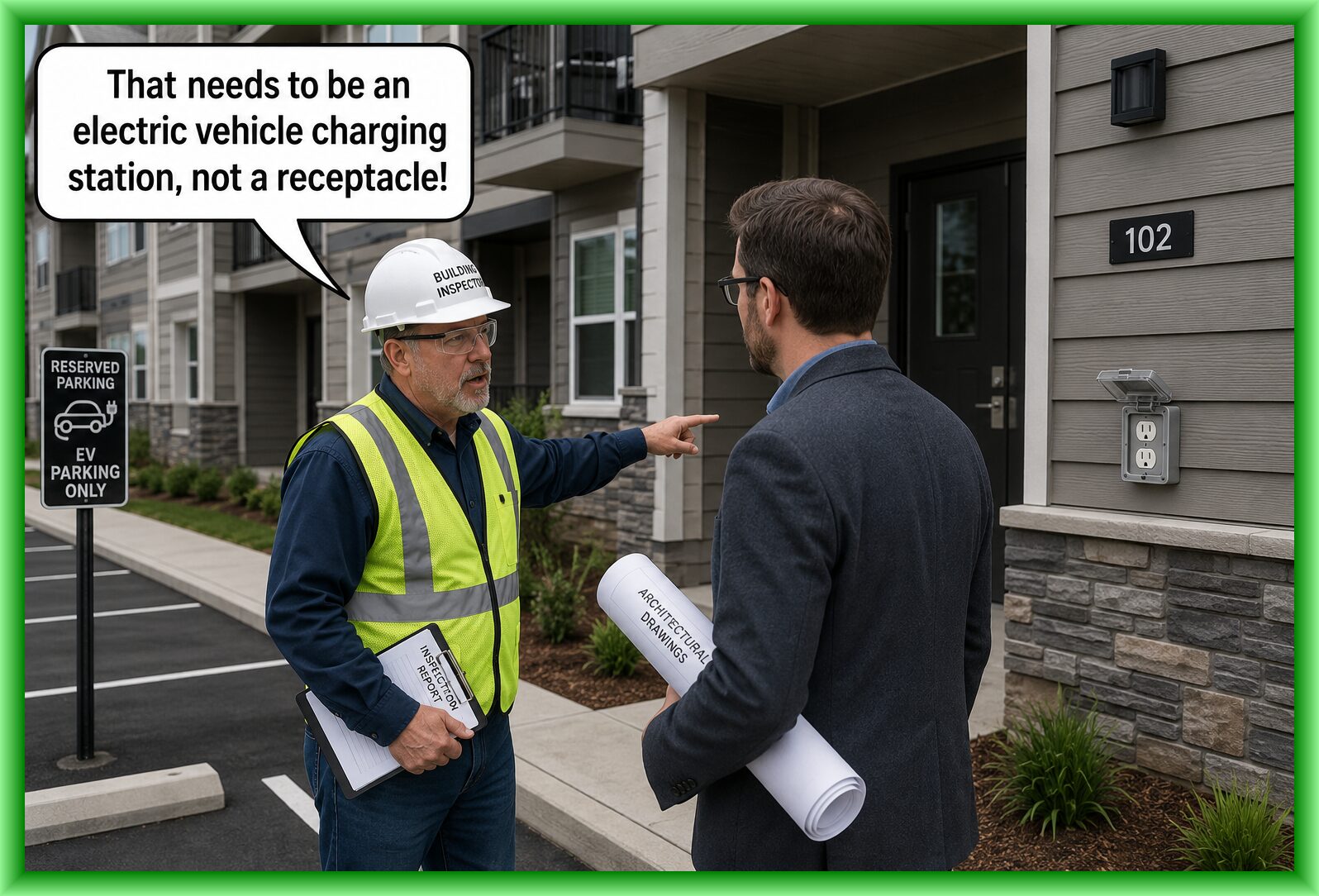
d. EV Chargers. Notwithstanding anything in this section to the contrary, at least ten (10) percent of the total number of parking spaces shall be equipped with fully-operational Level 2 EVSE.
Someone screwed up here and created an expensive source of confusion. First off, the referenced subparagraph “d.” cannot be added to the end, because subparagraph “d.” already exists in the code. It references the Receptacle Power Source.
In addition, the 2025 CalGreen Code already requires a functioning electric vehicle charging receptacle for every dwelling unit.
Since the code provides for EV charging for every unit, the county’s addition of the requirement that 10% of these have some (undefined) smart functions defies comprehension. Honestly, I don’t think the author of the amendment understood the CalGreen Code requirement. Either that or they were reading the 2022 code, in which case such an amendment would at least make sense.
The bottom line is that if you have a multifamily project in Contra Costa County, it would behoove you to meet with the building department to clarify this wacky requirement. But please be nice when you talk to them. They have a challenging job with little control over these types of issues.
CG Section 4.408.1 Construction Waste Management
This amendment eliminated subparagraph 2, which allowed for alternative waste diversion methods under certain circumstances.
CG Section 4.408.2 Construction Waste Management Plan
This amendment requires county approval of the plan and specifies a compliance process that differs slightly from the code. This is essentially a contractor issue and not a design issue.
Section 4.408.5 Documentation. This specifies how the contractor is to document waste recycling and provides additional guidance from what is in the code.
CG Table 5.106.5.3.1 (EV Capable Spaces and EVCS) of CGBSC Chapter 5 (Nonresidential Mandatory Measures) is amended to read:
TABLE 5.106.5.3.1 – EV CAPABLE SPACES AND EVCS
|
TOTAL NUMBER OF ACTUAL PARKING SPACES |
NUMBER OF REQUIRED EV CAPABLE SPACES |
OTHER THAN OFFICE AND RETAIL NUMBER OF REQUIRED EVCS2, 3 |
OFFICE AND RETAIL NUMBER OF REQUIRED EVCS2, 3 |
| 1-9 | 0 | 0 | 0 |
| 10-25 | 4 | 3 | 3 |
| 26-50 | 8 | 5 | 6 |
| 51-75 | 13 | 8 | 8 |
| 76-100 | 17 | 10 | 13 |
| 101-150 | 25 | 15 | 19 |
| 151-200 | 35 | 20 | 26 |
| 201 and over | 20 percent of actual parking spaces1 | 50 percent of EV capable spaces1 | 75 percent of EV capable spaces1 |
The numbers that are bold in the table have been changed from the code. In all cases, the numbers have increased. This could be a very expensive revelation at the end of the project. Why the county chose to make these random changes is anyone’s guess.
For an explanation of the difference between EV Capable and EVCS, see our informative article here.
CG 5.408.1 Construction Waste Management
The county made the same changes to the nonresidential construction waste management requirements as they did with the residential requirements. For the sake of brevity, I will not repeat the information here.
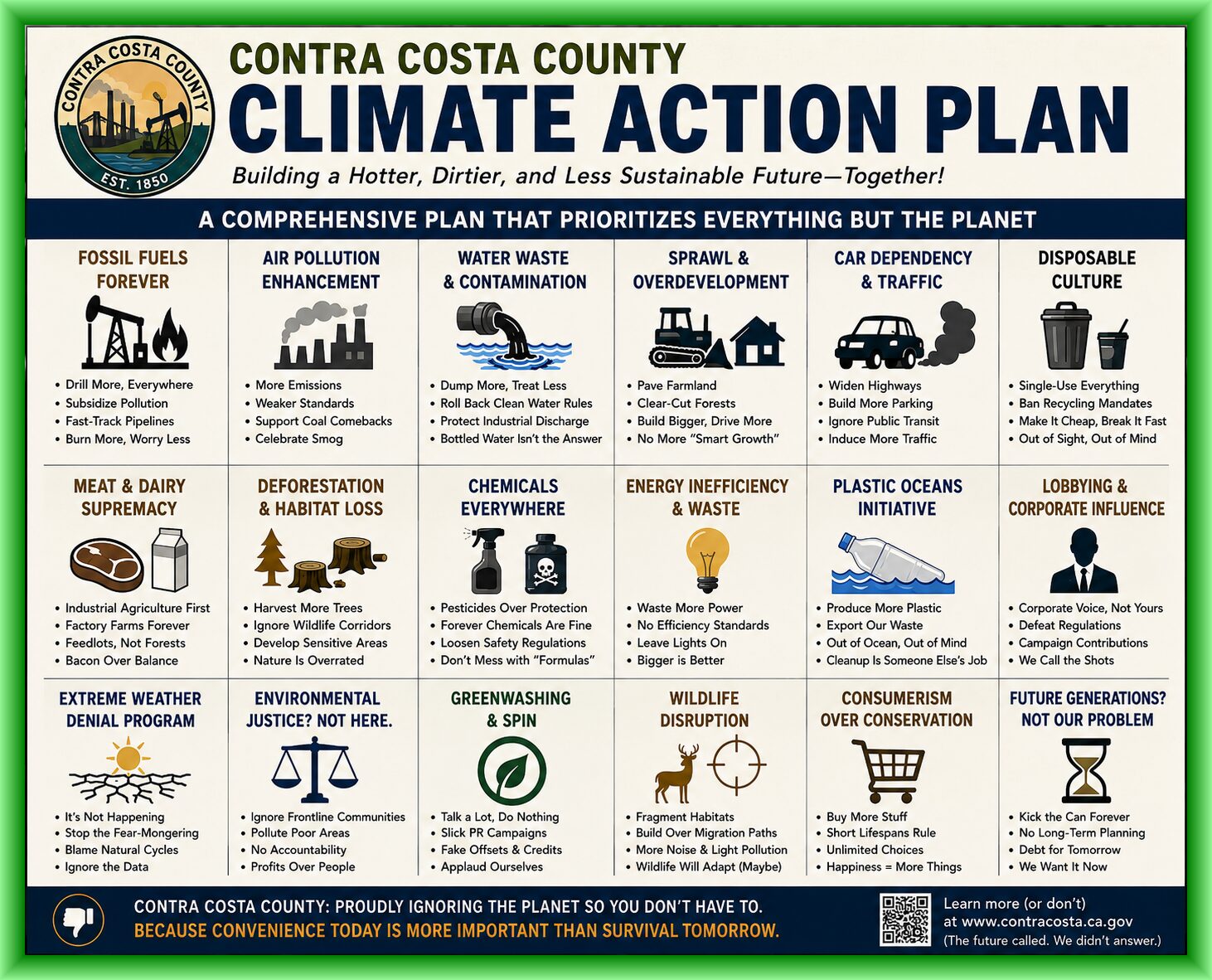
We have poked some fun at Contra Costa County here, but the simple fact is that they are no better or worse than hundreds of other building departments in the State of California. And like all the others, the building departments are at the bottom of the county budget food chain. There is no money for more plan reviewers or inspectors. There is no money to pay for website technicians. There is no money to pay for the training required to keep up with the ever-changing building codes that they have no control over. So the next time you meet with a permit technician or building inspector, take a minute to appreciate the challenges they are faced with. It’s a thankless job, but it needs to be done.
If In Doubt, Call Us
CalGreen for Contra Costa County is confusing. We can help with your residential or commercial project, including commissioning.
At CalGreen Energy Services, we are specialists in the CalGreen Code. CalGreen is our only business. If you have a CalGreen question, please feel free to give us a call. We are happy to share our knowledge.
Call us today and let us show you how we can help with your project.
Gary Welch
Email: gary@calgreenenergyservices.com
Phone: 707-328-5299

Gary Welch has over 35 years experience in the field of sustainable building design. He is the CEO of CalGreen Energy Services. Gary is an ICC Certified CalGreen Special Inspector and Plans Examiner.