
CalGreen Compliance for Architects
CalGreen compliance for architects can be challenging for several reasons.
The first is that many jurisdictions in the state do not enforce the Green Building Standards Code during permit review or inspections. Almost every building department in the state is underfunded and understaffed. As a result, CalGreen Code enforcement is the low-hanging fruit as it is easily ignored with little chance of subsequent problems.
Most architectural firms face similar challenges, including tight budgets and demanding schedules. The lack of enforcement by local building departments also results in architects saving time by doing the bare minimum regarding CalGreen Code compliance.
This same thing occurs during construction. Many contractors are unfamiliar with the CalGreen Code requirements since building inspectors in many locations do not hold them accountable.
Additionally, it’s important to know that almost every building department has its own checklist requirements. There is no standard checklist that is acceptable throughout California.
You must use the checklist approved by the building department in your project’s jurisdiction.
When starting a new project, you can visit the building department’s website to determine which checklist to use. Unfortunately, many building departments haven’t updated their website since Steve Jobs was a baby. You may need to call or email them to determine which checklist to use. As a last resort you can call or email us and we can tell you which one is required. Of the 528 building departments in the state, we have requirements for about 480 of them.
Some jurisdictions in the state require an ICC-certified CalGreen Special Inspector to complete the checklist. These jurisdictions are primarily located in Northern California and include Cupertino, Los Altos, Palo Alto, Hillsborough, San Francisco, Marin County, Santa Rosa, Sonoma County, Napa County, San Anselmo, Rocklin, Petaluma, Rohnert Park, Tiburon, and a few others. In these locations, you will need to hire a CalGreen specialist.
In most other jurisdictions, the architect or designer may fill out the checklist themselves.

CalGreen Scope
The scope of the CalGreen Code applies to “the planning, design, operation, construction, use and occupancy of every newly constructed building or structure, unless otherwise indicated in this code, throughout the State of California (CG101.3).” Note that the use of the term “structure” could encompass everything from a shed to an outhouse and everything in between.
For residential additions and alterations (CG 301.1.1):
The mandatory provisions of Chapter 4 shall be applied to additions or alterations of existing residential buildings where the addition or alteration increases the building’s conditioned area, volume or size. The requirements shall apply only to and/or within the specific area of the addition or alteration.”
To clarify, “volume” would include raising the ceiling of an existing space.
A few things to understand about the checklist process. In every case, a checklist must be placed on a drawing sheet, the same size as the rest of the permit plans. The checklist sheet is included in the permit plan submittal. You cannot submit a letter-sized checklist for permit.
In most cases, the language on the checklist is an abbreviated version of the language in the code. It is important to have a copy of the current California Green Building Standards Code. You can purchase digital access, a PDF, or a hard copy from the International Code Council website here.
CalGreen compliance for architects can get more complicated where some jurisdictions have adopted Tier 1 or Tier 2 of the CalGreen Voluntary Measures. These include Santa Rosa, Rohnert Park, Petaluma, Mill Valley, Novato, Palo Alto, San Anselmo, San Rafael, Santee, Tiburon, Windsor, and possibly a few more. Navigating the voluntary measures requires an in-depth knowledge of the code, and you would be wise to engage a CalGreen consultant.
In summary, you should first determine if your project requires a CalGreen checklist submittal. Next, determine which checklist to use. Finally, complete the checklist and place it on the drawing sheet(s) to match your architectural sheet size. Then submit it for permit along with the rest of your plans.
What If I’m Not Sure of the Intent of a Requirement?
You can try calling the building department’s plan desk. My experience is that the permit technicians are woefully unfamiliar with the CalGreen Code and won’t be able to provide much guidance.
You can try the California Energy Commission’s Energy Standards Hotline at (800) 772-3300. My experience is that they are pretty good on Title 24 questions, but have less knowledge on the CalGreen code. In case you didn’t know, the California Energy Commission authors both the Energy Code and the CalGreen Code.
A very good source that explains the intent behind many of the requirements is published by the International Code Council, the publishers of the California Building Codes. The book, called the Guide to the Green Building Code is published at each code cycle and provides insight into many of the requirements. It can be purchased at https://codes.iccsafe.org/codes/united-states/california.
If all else fails, call us at the phone number at the bottom of this article. We are happy to share our knowledge.
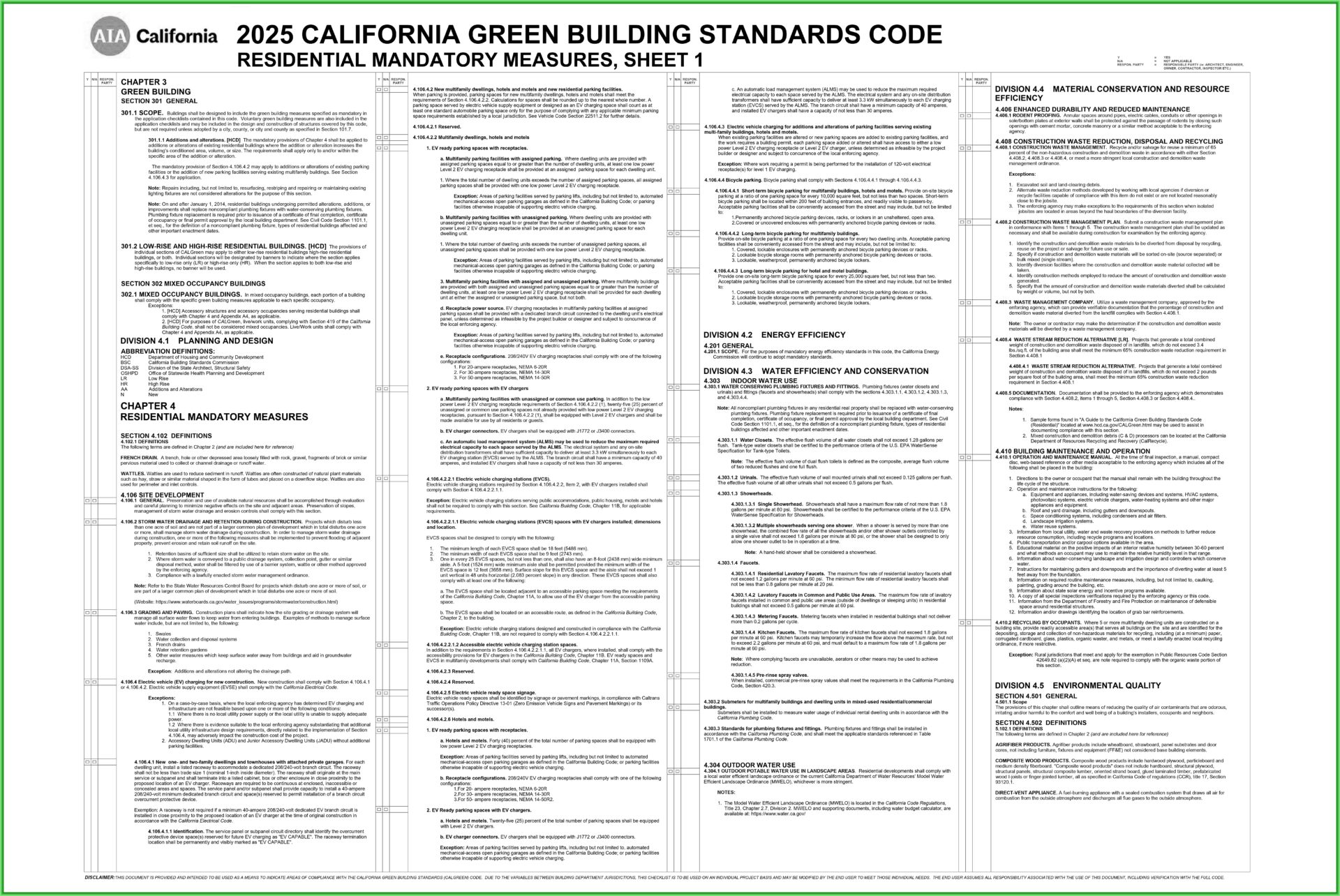
Page 1 of the AIA Residential Mandatory Measures
Filling Out the Checklists
The AIA Residential Checklist
The AIA CalGreen Mandatory Measures Checklist includes requirements for single-family homes, ADUs, hotels, motels, assisted living residences, condominiums, and other facilities that include sleeping accommodations. First off, the checklist must be properly completed and tailored to your specific project. We see a number of permits that are submitted with a blank, unedited checklist. This is a recipe for problems with CalGreen compliance for architects. It is not the contractor’s responsibility to determine what CalGreen Code items apply and how they affect your project. This is the responsibility of the architect and/or designer. The AIA checklist includes three columns to the left of each requirement. The box in the first column is checked if the item is applicable to your project. If applicable, you must note in the third column who is responsible for this work. More than one team member may be responsible for a single item. If this is the case, note all team members responsible (ie: architect & contractor). Also, and this is most critical, for each applicable item, you must include a corresponding note or detail on the plan. The box in the second column is checked if the requirement is not applicable. If so, you must explain in the third column why the item is not applicable. You cannot just check “NA” without providing an explanation. The completed checklist must be placed on a drawing sheet to match the architectural sheet size and submitted for permit, along with the balance of the plan set.
The AIA NonResidential Checklist
The AIA NonResidential Mandatory Measures Checklist is four sheets long and contains dozens of complex requirements that are not fully explained. It’s important to understand that the checklist language is, in most cases, an abbreviated version of the actual code language. It is important to read the full text of each requirement in the CalGreen Code itself. Filling out the checklist is identical to the process noted above for residential projects. Again, it is critical to provide an explanation why an item is not applicable. Also, it is very important to have a note or detail on the design drawings for every applicable item on the checklist. The checklists are a tool for the plan reviewers to verify that the design team understands and has properly incorporated the applicable requirements into their design. The checklists themselves do not impose an obligation on the contractor. Failure to include specific guidance for each checklist item on the design drawings may result in an expensive change order and delays in closing out the project! Unless you are very familiar with the CalGreen Code and its intent, it may be advisable to engage a CalGreen specialist to assist with the checklist.
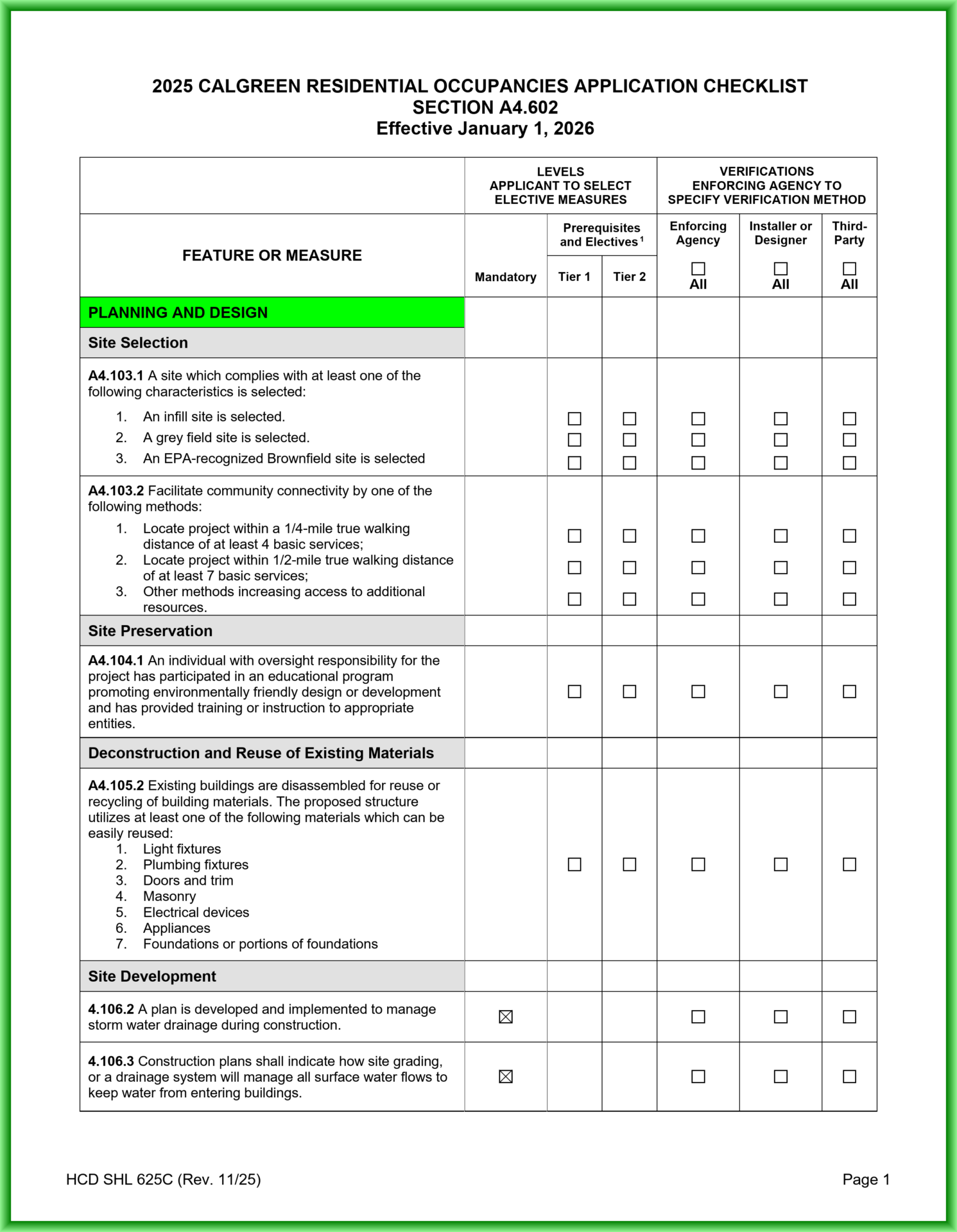
Page 1 of 13, 2025 HCD Checklist
The HCD Checklists
Some jurisdictions require the use of the checklists published by the California Department of Housing and Community Development. The residential checklist is thirteen pages long and includes the Mandatory Measures, Tier 1, and Tier 2 requirements (download here). The addition of the Tier requirements and the complex format make this checklist challenging to use. Note that any requirement that begins with an “A” is a Tier requirement and likely not applicable to your project. When filling this out, you should note in the “Mandatory” column where in the design documents the requirement is shown – ie: “Drawing A-1”. If the item is not applicable, you should provide a brief explanation as to why it is not applicable in this column. The checklist also includes columns to identify the Enforcing Agency. In many cases, the enforcing agency will be the local building department. Other options include the Installer or Designer, and Third-Party CalGreen Inspector. If unsure, your building department can provide guidance. Once completed, the checklist should be placed on a full-size drawing sheet(s) and included in your permit plans set.
HCD does not produce nonresidential checklists because such projects are beyond its jurisdiction.
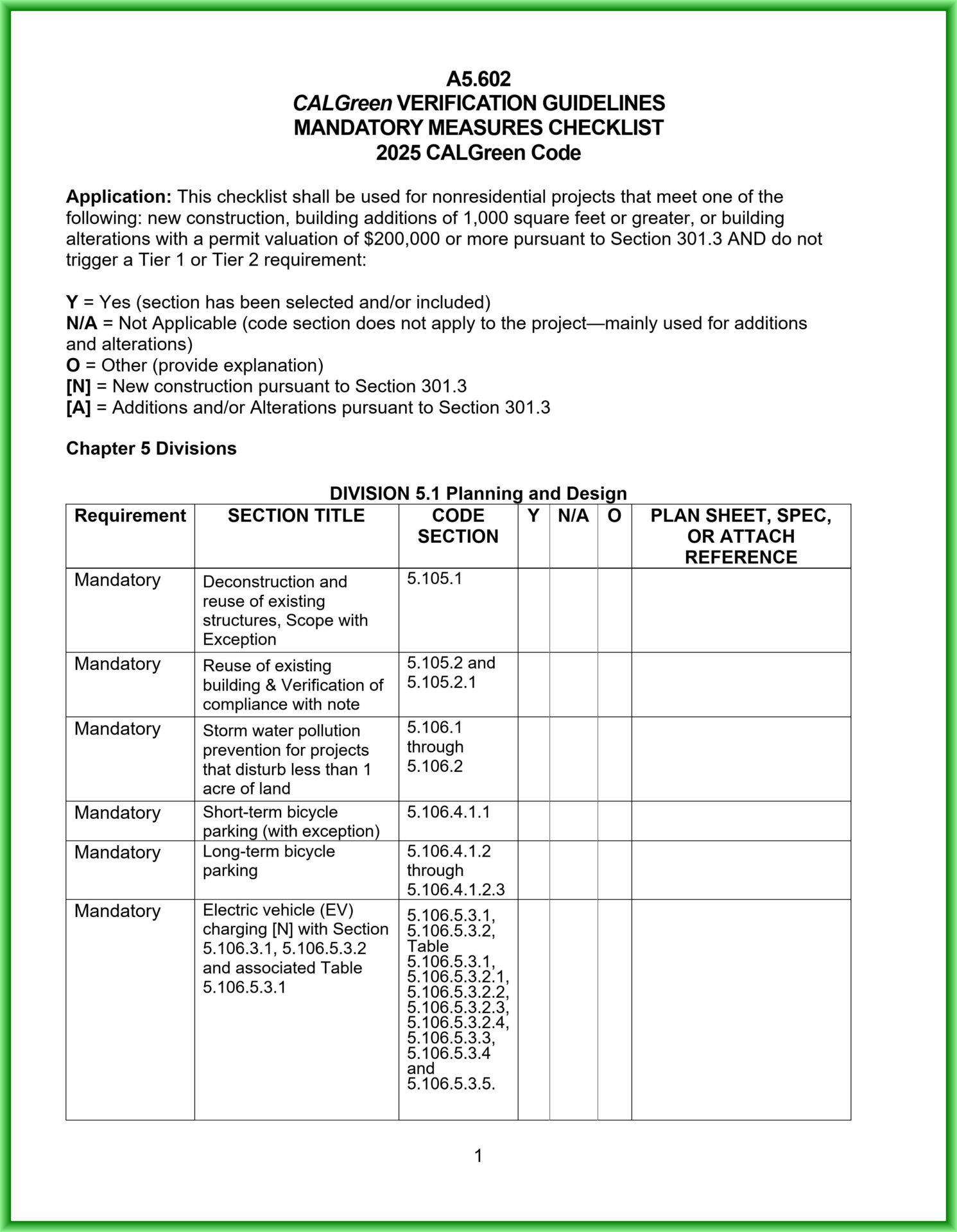
Page 1 of 8, 2025 CalGreen Code Checklist
The CalGreen Code Checklists
Many jurisdictions want to see the residential checklist from the CalGreen Code itself. This checklist (download here) is the most challenging to use as it provides zero explanation of the requirements. It simply lists the section number and title. You must use the checklist in conjunction with a copy of the CalGreen Code. As with the other checklists, you must note where the requirement appears in the permit documents or explain why it is not applicable. Once complete, the checklist should be placed on a full-size drawing sheet(s) and included in your permit plans set. Please note that the linked checklist has been downloaded from the California Building Standards Commission website. You can download the complete series here under CalGreen Checklists and Worksheets. These include the non-residential and residential checklists for Tier 1 and Tier 2 projects. Also included are the Construction Waste Management Plan and Worksheets, as well as information on Life Cycle Assessment for large projects.
What Else?
The intent of the checklist is to verify that the CalGreen requirements are shown on your plans.
The above statement does not seem well understood by many architects and designers. The checklist itself does not impose a clear obligation on the contractor. It is not considered a “design document” because many parts of it do not clearly define the project’s scope of work. The checklist is a tool for the building department to document that the designer understands the CalGreen requirements and has included them in their design drawings.
Every applicable item on the checklist must have a corresponding note or detail on the design drawings. You cannot rely on the permit technician to note any missing CalGreen requirements. In almost all jurisdictions, they won’t do it. As the design professional, you have certified that you have addressed all issues by submitting the checklist.
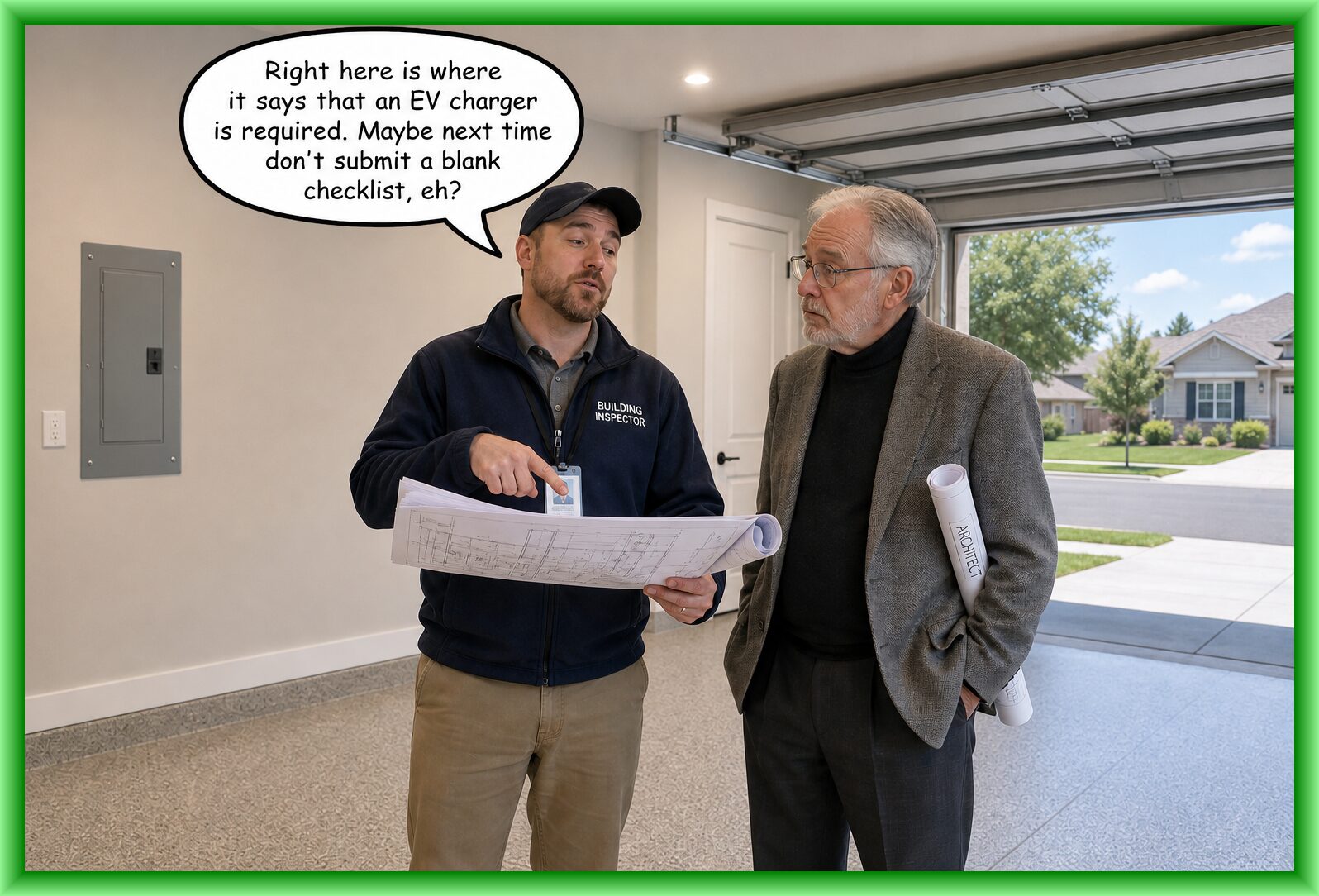
There is one group of people who carefully review the CalGreen compliance for your project. That is the building inspector. It is not uncommon for us to receive a call from a panicked architect who failed to specify an EV charger station that was clearly required by code. However, they had submitted a blank checklist for the permit submittal and only found out at the end of the project that it was required.
Submitting a blank CalGreen Checklist for a permit is a clear lack of due diligence and exposes your company to significant liability. One that would not require Ruth Bader Ginsburg to prove negligence. This is when CalGreen compliance for architects becomes a financial issue.
As if the various checklists were not confusing enough, there is another aspect of CalGreen compliance that may not be included in them. In fact, there are two other ways this can occur.
The first is the concept of “Reach Codes“. A reach code is a local building ordinance that “reaches” beyond state minimum requirements for energy efficiency, water conservation, or greenhouse gas reduction in new and existing buildings. These policies are designed to reduce emissions, improve public health, and encourage new technologies. Common examples include requirements for all-electric construction, increased electric vehicle (EV) charging, and stricter energy standards. Often, jurisdictions adopt Reach Codes outside the normal building code compliance process. Some examples of municipalities that have adopted these codes are Palo Alto, Fremont, Los Altos City, Healdsburg, Santa Clara City, Hayward, Menlo Park, Berkeley, Cupertino, Santa Monica, Santa Barbara, Irvine, and others. The way to determine if your project is subject to a Reach Code is to review the published municipal code. You can usually access these from the local website or directly at https://library.municode.com/ . Once there, look for the chapter titled “Building Codes,” “Building and Construction,” or similar.
Secondly, some cities and counties will adopt specific green, sustainable, or energy-related requirements due to local preferences or concerns. These, too, can be found in the local municipal code.
If In Doubt, Call Us
At CalGreen Energy Services we are specialists in the CalGreen Code. CalGreen is our only business. If you have a CalGreen question please feel free to give us a call. We are happy to share our knowledge.
Call us today and let us show you how we can help with your project.
Gary Welch
Email: gary@calgreenenergyservices.com
Phone: 707-328-5299


Gary Welch has over 35 years experience in the field of sustainable building design. He is the CEO of CalGreen Energy Services. Gary is an ICC Certified CalGreen Special Inspector and Plans Examiner.