
Building Commissioning for the S.F. Bay Area
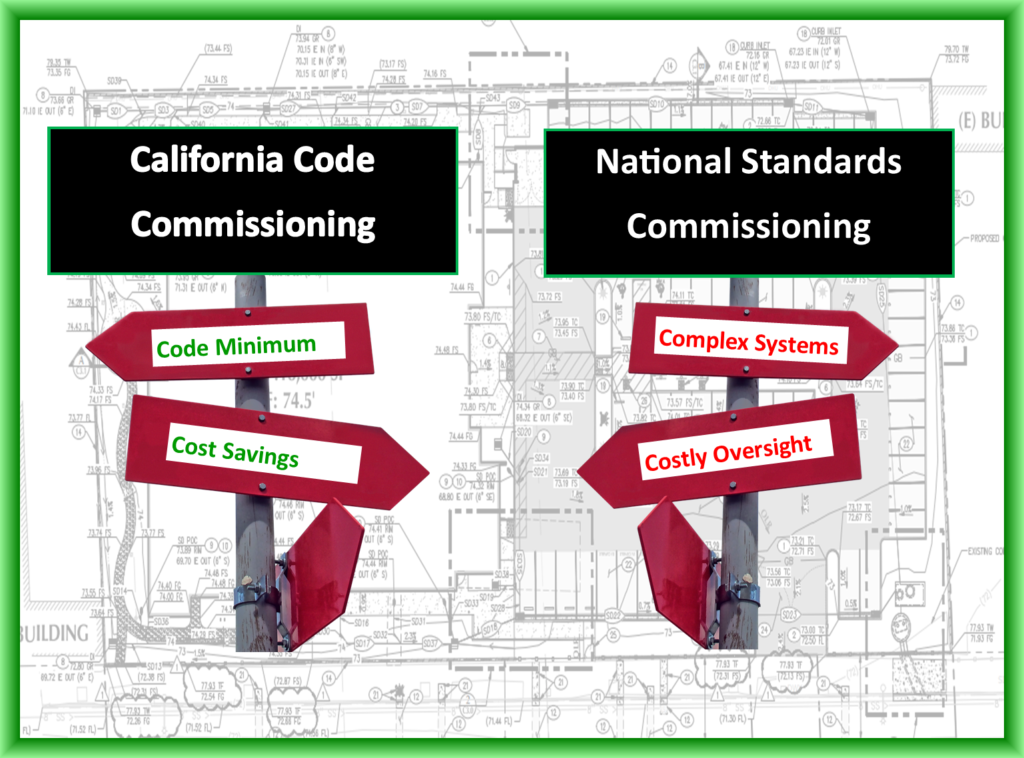
Building commissioning for the SF Bay Area comes in two varieties. Understanding the difference is critical, so let’s clarify it now.
The first is the “national standard” type of commissioning. This type of commissioning comes in three versions. These include the Associated Air Balance Council (AABC), the Building Commissioning Association (BCxA), and the Leadership in Energy and Environmental Design (LEED).
The second type of building commissioning is specific to California and is defined in both the California Green Building Standards Code (CalGreen) and the California Energy Code (misappropriately referred to as “Title 24”).
These two types of commissioning (Cx) differ significantly in both the scope of the commissioning effort and the responsibilities of the person providing the commissioning services.
A key difference is that the national standard type is chosen by either the A&E design team or the building owner.
The California Building Code commissioning is mandated by state code and is not optional.
What are the Differences Between the Two Types of Commissioning?
Both aim to ensure the system ultimately turned over to the owner complies with the approved plans and functions as designed.
Under the California Code requirement, there is a specific emphasis on ensuring the energy-consuming portions of the building comply with the approved Title 24 Energy Report.
Specific Differences Include the following:
AABC, BCxA, and/or LEED
- The owner or design team chooses which systems to commission. This usually involves many more systems than code requires.
- AABC is typically chosen when the building involves complex systems integrated into a central energy management and control system.
- LEED is typically mandated for most federal government projects and many municipal projects. An owner may also choose it when they want a more extensive sustainability program that extends beyond systems and equipment. LEED may also be used to market the project as meeting one of the LEED standards (Certified, Silver, Gold, or Platinum).
- Requires certification either as a Certified Commissioning Authority (CxA), BCxA, or LEED professional to manage the effort.
- The CxA, LEED Professional, or BCxA becomes an integral member of the design team from schematic design through project completion.
- Mandates an onsite inspector as part of the construction team.
- Mandates a minimum number of test procedures to be witnessed by the onsite inspector.
- AABC and BCxA focus primarily on system operation, while LEED expands to include decarbonization, quality of life, and ecological conservation issues.
- The LEED process is typically more expensive from a design and construction perspective (unless you believe the marketing…).
- AABC, BCxA, and LEED processes exceed the California Code commissioning requirements and may be used to demonstrate compliance with the California Building Code.
California Code Commissioning
- Is required by both the California Green Building Standards Code and the California Energy Code (both codes are written by the California Energy Commission and intended to work together).
- Is required for all new buildings over 10,000 square feet.
- Is intended to provide a basic level of commissioning to help ensure smaller projects are completed in accordance with the Title 24 report and that specific systems are operating as designed before being turned over to the owner.
- Limits the number of systems that must be commissioned, which are related to energy and water consumption.
- Allows those with proven relevant experience to act as the “Commissioning Coordinator” without specifying a certification requirement.
- Does not meet the requirements of AABC, BCxA, or LEED.
- Requires the commissioning coordinator to perform a design review of the project, but does not require extensive involvement in the design phase.
- Does not require extensive onsite supervision by the Commissioning Coordinator.
- Requires the commissioning coordinator to complete a Final Commissioning Report that must be turned over to the building department to close out the commissioning portion of the permit.
- Is significantly less expensive from both a design and construction perspective.
CalGreen and Title 24 Commissioning
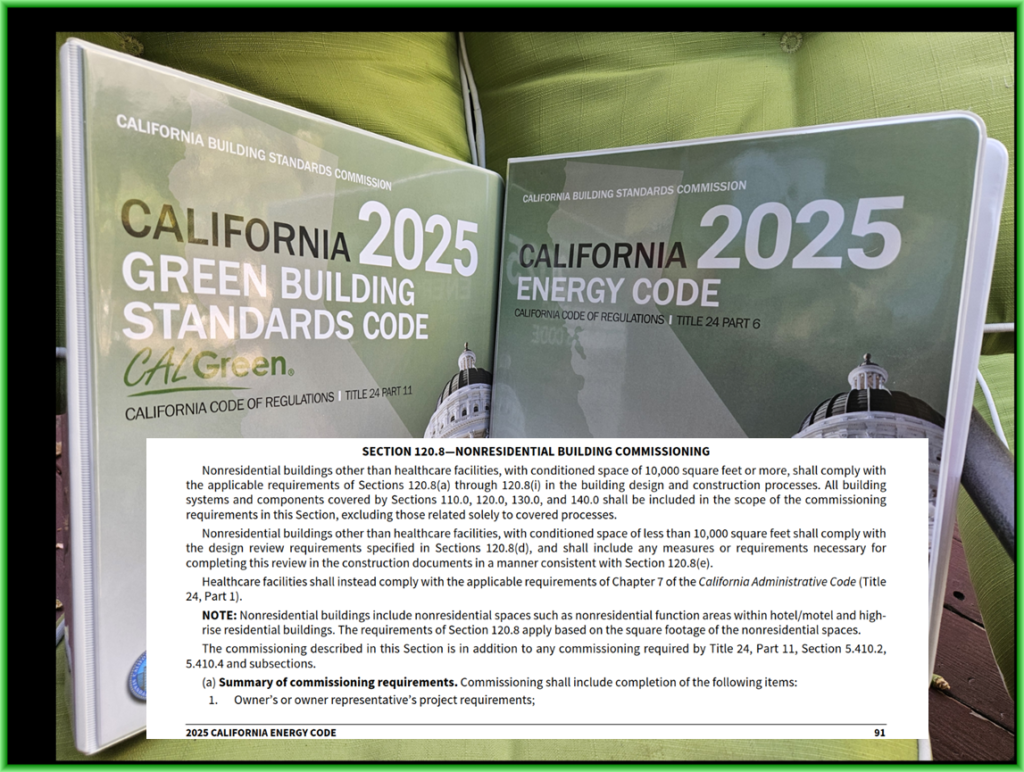
Two codes, one requirement. That’s essentially it. Both the CalGreen Code and the Energy Code (Title 24) require commissioning on all new buildings over 10,000 square feet.
In some cases, extensive renovations or a change in occupancy may also require commissioning for an existing building.
The California Energy Commission (CEC) authors both the CalGreen and Energy Codes. The commissioning effort is intended to be handled as a single process and not two separate efforts. The code requirements are essentially identical; however, the Energy Code adds building insulation, windows, and doors to the Cx scope.
When the California Energy Commission decided to add commissioning to the codes, it understood that it needed a less expensive process than the national standards. For this reason, it did not adopt AABC, BCxA, or LEED. While these organizations can bring value to complex projects, they require costly onsite observation and testing that is hard to justify on smaller, less complex projects.
The California Energy Commission wanted to provide a reasonable level of commissioning without the cost burden of the national standards. As a result, they created specific commissioning requirements detailed in both the CalGreen Code and the Energy Code.
Fun fact: The California Energy Commission requires that all commercial packaged HVAC equipment sold in California have built-in fault detection and alarm systems. The equipment includes a built-in LED panel that tells you exactly what is wrong with the unit. You simply don’t need to spend good money on extensive commissioning efforts to find out something is wrong with your new equipment. Just read the LED screen.
The CEC created a simple commissioning process that is effective for less complex projects. These may include travel hotels, wineries, retail stores, car dealerships, medical offices, storage facilities, sports centers, grocery stores, charter schools, warehouses, maintenance shops, distribution centers, office buildings, and similar projects. They defined a cost-effective effort that focused on the basic energy and water-consuming portions of the building.

Commissioning in the S.F. Bay Area
Whether it’s San Francisco, Oakland, San Jose, Palo Alto, Redwood City, Alum Rock, or any other Bay Area city, code-required commissioning is identical. All jurisdictions follow the code’s specific requirements without modification.
Unfortunately, some commissioning organizations try to sell national-standard commissioning services to unsuspecting clients when meeting the code minimum makes more sense. While these more extensive processes will meet the code, they cost the owner significantly more with little additional benefit for less complex projects.
It is not uncommon for us to quote a project and have a skeptical client ask, “Why are we so cheap? Your competitor is asking three times that amount.”
When this happens, we don’t criticize the competition. A national standard commissioning process can add real value for certain projects. The decision of which process to use should be based on the project’s complexity and the owner’s level of concern. We will help the owner make the right decision for their project.
If you have a large project with a central energy management and control system, national standard commissioning is probably the best fit. If long-term sustainability or building marketing is important, consider LEED. If not, then AABC or BCxA might be the right choice.
For projects that use VRF, packaged rooftop units, or similar equipment systems, meeting the code’s minimum requirements is more than adequate and can save the project thousands of dollars.
CalGreen Energy Services specializes in California Code commissioning. We no longer do national standard commissioning.
If you have questions about which type of commissioning is right for your project, please call us. We are happy to share our knowledge, even if that means passing you off to a company that does national standard commissioning.
Email or call us now to see how we can help you:
Gary Welch
Email: gary@calgreenenergyservices.com
Phone: 707-328-5299
For more information on the details of commissioning, see our informative article here:

Gary Welch has over 35 years experience in the field of sustainable building design. He is the CEO of CalGreen Energy Services. Gary is an ICC Certified CalGreen Special Inspector and Plans Examiner.